


Air Transport of Sports Equipment: What Solutions Are Available for Bulky Equipment?

Travelling for a sports team does not only involve the athletes. Depending on the discipline, the team may also need to transport several hundred kilos of sports equipment, sometimes bulky, fragile or subject to specific handling constraints.
Bicycles, automotive equipment, boats, boards, technical equipment or team equipment: transporting them can quickly become complex, particularly in the context of an international competition. Air transport of sports equipment helps reduce delivery times and better coordinate the team’s travel with that of its equipment.
For clubs, federations, organisers or professional teams, several solutions are available. The choice depends in particular on the volume transported, the destination and scheduling constraints.
Why transport sports equipment by air?
Air transport addresses several issues faced by sports teams when they need to move their equipment over long distances.
Saving time for international competitions
When a team takes part in a competition abroad, delivery times become an essential part of the organisation.
Compared with certain forms of road or sea transport, air freight generally makes it possible to significantly reduce the time required to transport equipment. This speed is particularly useful when several competitions take place in succession or when the equipment needs to arrive shortly after the team.
Transporting sports equipment by air also makes it possible to better synchronise the arrival of the equipment with that of the athletes and technical teams.
Transporting bulky and specific equipment
Not all sports equipment can travel as standard baggage. Some disciplines require particularly bulky items or equipment with specific characteristics.
Teams must therefore take into account dimensions, weight, fragility, packaging and handling requirements before departure.
Transporting bulky sports equipment sometimes requires specific organisation: choosing the aircraft, preparing the loading process, checking cargo door dimensions or organising ground operations.
What solutions are available for transporting bulky sports equipment?
There is no single solution suited to every situation. The choice depends in particular on the amount of equipment, its size, the destination and the team’s schedule.
Air freight for oversized equipment
Air freight is a suitable solution when equipment cannot travel with a team’s usual baggage.
Before transport, teams must assess several factors: total weight, dimensions, packaging and any specific characteristics of the equipment.
Depending on the volume involved, they can place the equipment on pallets or in suitable containers to facilitate loading and limit the risk of damage.
Careful preparation also makes it possible to anticipate constraints related to the departure airport, arrival airport and the type of aircraft used.
Chartering an aircraft for a team or competition
For certain trips, chartering an aircraft can be a particularly suitable solution.
It makes it possible to organise a flight according to the team’s specific requirements, particularly regarding schedules, routes or loading capacities.
Teams may consider this solution when a large amount of equipment needs to travel with the athletes or when scheduled flights do not provide sufficient options.
Avico offers solutions adapted to sports clubs, with an aircraft selection that takes into account the number of passengers, the programme and the requirements associated with transporting equipment.
Chartering therefore facilitates the overall coordination of the trip by taking into account both the athletes and their equipment.
Coordinating transport and ground operations
The flight represents only one part of the equipment’s journey. The organisation must also cover the stages before departure and those following arrival.
This includes arranging transport to the airport, loading, handling, unloading and then transfer to the competition or training venue.
Good coordination between the different parties involved helps reduce the risk of delays or disruptions in the logistics chain.
As part of a charter operation, Avico can also take into account the operational and logistical constraints associated with the journey in order to build a solution suited to the entire operation.
What sports equipment may require specific air transport?
Requirements vary considerably depending on the discipline. However, some sports involve particularly bulky or difficult-to-transport equipment.
Vehicles and motorsport equipment
Motorsport competitions require significant logistics. Depending on the event, teams may need to transport vehicles, as well as spare parts, tyres, tools or equipment intended for technical teams.
Time constraints become particularly significant when several international competitions take place in succession in different countries.
Air transport can then make it possible to move certain essential equipment quickly between two stages.
Before the flight, teams must nevertheless assess the weight of the vehicles, their dimensions, loading conditions and securing requirements.
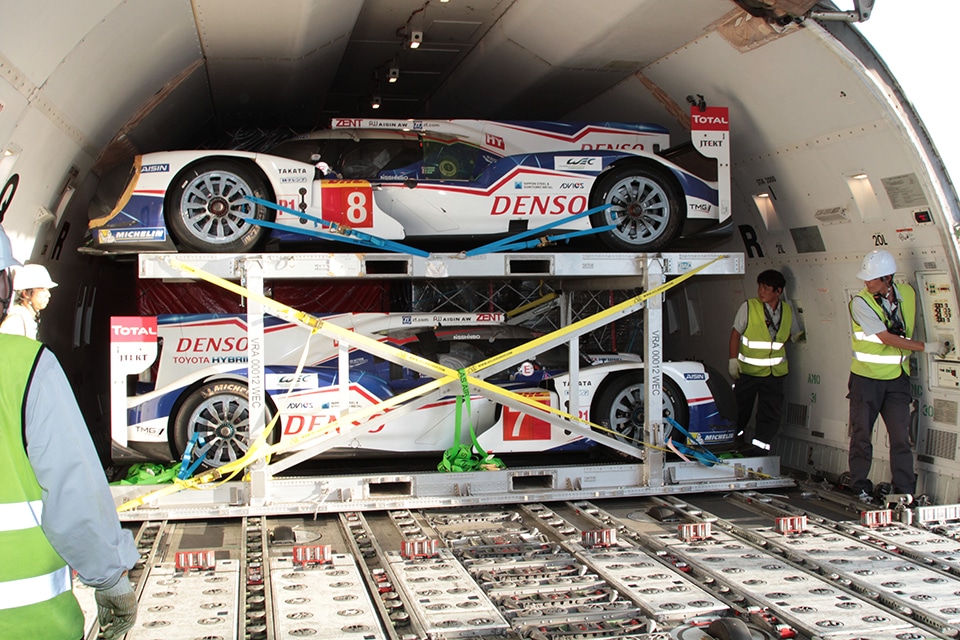
Bicycles, boats, boards and oversized equipment
Competition bicycles, boards or certain boats also present specific constraints.
Their shape and dimensions sometimes make them more difficult to handle than standard baggage. Suitable packaging and protection can therefore help limit the risk of impact during transport.
In some cases, an entire team needs to transport several dozen similar items at the same time.
The total volume then becomes an essential criterion for determining the most appropriate transport solution.
Technical equipment and team equipment
A sports team may also transport equipment intended for training, physical preparation, performance analysis or technical operations.
This may include equipment cases, electronic equipment, devices authorised for transport or specific parts used for the sporting activity.
Teams must inventory these items in order to know precisely the volume and weight to be transported before organising the flight.
How to organise the air transport of a sports team?
The success of the trip largely depends on its preparation. The earlier teams identify the constraints, the more effectively they can put a suitable solution in place.
Anticipating weight and dimension constraints
The first step is to establish a precise inventory of the equipment.
For each item, it is useful to identify:
- its dimensions;
- its weight;
- its packaging;
- its level of fragility;
- any handling constraints.
This information makes it possible to determine the required capacities and check whether the equipment is compatible with the type of aircraft being considered.
It becomes particularly important when transporting competition equipment, when numerous items need to travel simultaneously.
Preparing the necessary formalities and authorisations
International travel may also require various administrative or customs formalities.
The documents required depend on the nature of the equipment, the countries concerned and the final destination.
Specific regulations may also apply to certain equipment. It is therefore preferable to identify these constraints sufficiently early in order to limit the risk of delays or issues at departure or arrival.
For operations involving specific constraints or requiring a high level of responsiveness, Avico also offers urgent charter and special flight solutions, with coordination of the regulatory, operational and logistical aspects associated with the flight.
Coordinating the arrival, transfer and handling of the equipment
The organisation must continue after landing.
Ground teams must unload and retrieve the equipment before organising its transfer to the stadium, circuit, training centre or competition venue.
This stage may require the involvement of several service providers, who must coordinate their operations with the team’s arrival.
As part of an international competition, this synchronisation helps prevent athletes from arriving at the venue while their equipment is not yet available.
Why use an air charter specialist?
Organising the air transport of sports equipment involves numerous parties: airlines, airports, ground service providers, transport operators, organisers and sports team managers.
Using an air charter specialist makes it possible to centralise the search for an air transport solution and coordinate the different parties involved in the flight.
Organisation adapted to the constraints of the competition
Each competition has its own constraints.
Dates may be fixed, arrival slots limited and equipment sometimes essential from the first hours following landing.
Organisers must therefore build the transport solution around the sports schedule rather than the other way around.
Depending on the requirements, Avico can search for an aircraft suited to the number of passengers, the volume of equipment, the destination and the scheduling constraints of the trip.
This approach makes it possible to build a charter solution adapted to the characteristics of each operation.
Operational monitoring of the journey
Effective organisation also requires monitoring the journey as a whole.
Schedules, regulatory constraints, ground operations and any changes must remain coordinated until arrival.
During a charter operation, Avico coordinates the various aspects involved in setting up the flight and can take into account the logistical connections upstream and downstream of it.
This monitoring helps limit unforeseen issues and maintain coordination between the different parties involved in the journey.
FAQ – Air Transport of Sports Equipment
What is the best way to transport bulky sports equipment?
The choice depends on the volume, weight, destination and available time. When equipment needs to travel long distances quickly, air transport can be a suitable solution.
Can bulky sports equipment be transported by air?
Yes. Certain air freight solutions make it possible to transport bulky or oversized equipment. However, its dimensions, weight, packaging and loading constraints must be checked before departure.
Why choose air transport for a sports competition?
Air transport makes it possible, in particular, to reduce delivery times and facilitate international travel for teams and their equipment. Chartering also offers greater flexibility in terms of schedules, routes and aircraft selection.
How can a sports team’s equipment be transported abroad?
The dimensions and weight of the equipment must first be determined, followed by its packaging, handling and any necessary formalities. The organisation must also coordinate its transport with the team’s travel programme.
Are authorisations required for international air transport?
This depends on the operation, destination, type of aircraft and nature of the equipment being transported. Certain operations require specific authorisations or formalities. Assessing the project in advance makes it possible to identify these constraints before departure.
Need to organise air travel for your team and sports equipment? Contact Avico to assess the constraints of your operation and identify a suitable solution.
votre lecture
Booking a flight for 10, 30 or 100 travelers does not follow the same rules as purchasing a few individual tickets. When a group travels on the ...
Only around thirty kilometres separate Nice Côte d’Azur Airport from Monaco. By road, however, that short distance can quickly become a ...
Air transport of competition horses requires precise organisation. When a horse needs to travel to an international competition, several elements ...