


Humanitarian Air Cargo Charter: Emergency Logistics for NGOs and Governments

When roads are cut off, borders close or commercial air services are disrupted, delivering relief supplies becomes a major challenge. Medicines, medical equipment, emergency shelters and food supplies sometimes need to travel thousands of kilometres within just a few hours.
In these situations, humanitarian air cargo charter enables NGOs, governments and international organisations to mobilise a dedicated aircraft. This solution offers greater flexibility for transporting essential goods, particularly to hard-to-reach destinations.
Humanitarian aviation therefore plays a central role in emergency response operations. In 2025, the United Nations Humanitarian Air Service (UNHAS), managed by the World Food Programme, transported more than 2,500 tonnes of light humanitarian cargo to nearly 362 remote or hard-to-reach destinations.
For more than thirty years, Avico has supported organisations facing complex aviation operations. Its teams coordinate urgent cargo missions, medical transport and air logistics in crisis zones.
Why Humanitarian Logistics Depend on Dedicated Air Cargo
When a crisis occurs, humanitarian organisations must act quickly. However, local infrastructure does not always allow goods to be transported through conventional channels.
An airport may operate only partially, a road may become impassable or commercial transport capacity may disappear.
Chartering a cargo aircraft for emergency relief then provides a suitable solution. It allows flight schedules, routes and transport capacity to be defined according to the actual needs of the mission.
Aircraft can transport hospital equipment, medicines, water purification systems, generators and supplies intended for teams operating on the ground.
However, air transport does not systematically replace road or maritime solutions. It is mainly used when urgency, access constraints or the nature of the cargo require specific arrangements.
Overcoming the Limitations of Commercial Transport During a Crisis
Commercial networks operate efficiently when infrastructure remains functional. However, a natural disaster, conflict or health crisis can disrupt these networks within hours.
Airlines may suspend flights, while travel restrictions complicate deliveries by road. In some cases, humanitarian goods no longer have access to any suitable commercial transport service.
The World Food Programme notably uses the UNHAS service to reach regions where safe surface transport and commercial aviation options are unavailable.
In this context, air charter for NGOs makes it possible to organise dedicated transport. The organisation defines its priorities, volumes and deadlines, then searches for an aircraft that meets these requirements.
The United Nations High Commissioner for Refugees (UNHCR) notably used this approach in 2011. A flight to Mogadishu transported more than 31 tonnes of emergency supplies to accelerate the delivery of aid.
To meet these needs, Avico offers air cargo charter solutions adapted to urgent goods, exceptional cargo and operations requiring specific coordination.
An Ongoing Activity Beyond High-Profile Crises
Humanitarian air assistance is often associated with earthquakes, conflicts or major natural disasters. Yet logistical needs exist throughout the year.
Droughts, floods, population displacement and regional health crises generate regular demand for equipment and supplies.
Even when media attention declines, organisations must continue supplying their operational bases. They must also replenish their stocks and maintain their response capabilities.
Humanitarian air logistics therefore depend as much on anticipation as on reaction.
Teams must examine airport infrastructure, overflight authorisations, cargo handling capabilities and onward transport conditions after landing.
Aircraft selection is also an essential step. The weight and dimensions of the cargo, together with runway characteristics, can influence the choice of cargo aircraft.
A successful operation therefore depends on the entire logistics chain, not simply on aircraft availability.
Who Uses This Type of Charter?
Humanitarian air cargo meets the needs of many different stakeholders. Despite their different missions, they all share one priority: delivering essential resources quickly to affected populations.
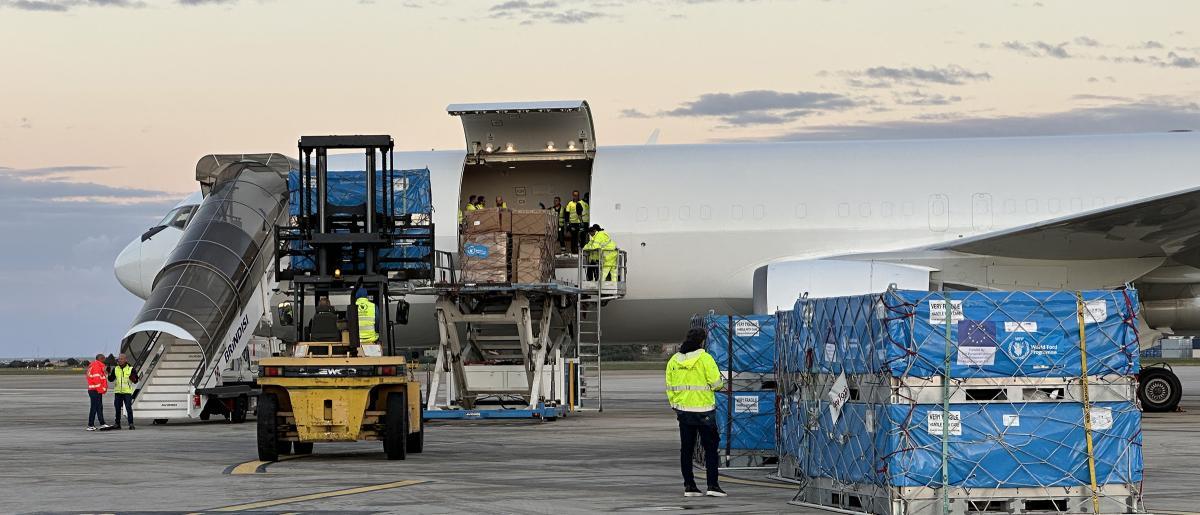
NGOs, Governments and International Organisations
Non-governmental organisations use air charter services to transport medicines, medical equipment, food supplies and essential goods.
Governments may also mobilise dedicated aircraft during a national disaster or an international assistance operation.
International organisations, meanwhile, coordinate interventions that sometimes require several modes of transport. Air cargo is then used to accelerate the most urgent deliveries.
UNHCR notably maintains emergency stocks near major logistics hubs. When a crisis occurs, air transport can help move these resources quickly.
However, an air logistics operation in a crisis zone requires careful preparation. It may include:
- Finding an aircraft suited to the cargo.
- Checking the capabilities of the destination airport.
- Obtaining traffic and overflight authorisations.
- Organising customs formalities.
- Preparing cargo loading and handling.
- Coordinating with ground handling teams.
- Operational monitoring through to delivery.
Each step contributes to the successful completion of the mission. The flight therefore represents only one part of the necessary organisation.
Examples: WFP, UNHCR and International Medical Agencies
The World Food Programme (WFP) and UNHCR illustrate the importance of air transport in humanitarian operations.
The UNHAS service, managed by WFP, transports passengers and light cargo to regions affected by conflicts and disasters. It operates when commercial connections can no longer meet humanitarian needs.
UNHCR also organises emergency airlifts. In 2014, during the Iraq crisis, a Boeing 747 carrying approximately 100 tonnes of humanitarian supplies was sent to Erbil.
This operation was part of a broader response combining several modes of transport. The aircraft accelerated the arrival of priority equipment, while other goods travelled by sea or road.
International medical agencies face additional constraints.
Certain medicines require specific transport conditions. Hospital equipment may also require special handling or have unusual dimensions.
Aircraft selection must therefore consider the cargo, delivery deadlines and technical capabilities at the destination.
This combination of transport methods allows organisations to adapt their response to each situation.
Avico’s Experience in Crisis Response
Humanitarian operations require speed, as well as a thorough understanding of technical and regulatory constraints.
With more than thirty years of experience in air charter, Avico manages missions requiring close coordination between airlines, freight forwarders, airports and local authorities.
Its teams can organise urgent transport and identify suitable solutions for complex destinations.
Responsiveness is an essential factor. For the most urgent missions, Avico’s operational teams can respond within a few hours, depending on the characteristics of the request and aircraft availability.
This expertise also extends to other sectors facing similar constraints. Industrial operations in remote regions sometimes require rapid transport, specialised aircraft and extensive local coordination.
Avico notably supports companies in the oil, gas and energy sector in organising air transport to complex environments.
297 Humanitarian and Medical Flights Coordinated During COVID-19
The COVID-19 pandemic profoundly disrupted international aviation networks.
Between March and June 2020, Avico coordinated 297 emergency flights, including repatriation operations, medical and healthcare cargo transport, the movement of response teams and medical evacuations.
This period required constant adaptation.
Border closures, health restrictions and the suspension of commercial flights complicated travel. At the same time, demand for masks, protective equipment and hospital supplies was increasing rapidly.
Each mission could require several authorisations, agreements with airports and specific loading arrangements.
Teams also had to coordinate the various stakeholders to minimise delays.
These 297 flights illustrate the importance of dedicated charter capacity when traditional networks can no longer ensure essential transport operations.
They also demonstrate the role of aviation in maintaining international medical and humanitarian operations.
More Than Thirty Years of Experience in Complex Environments
The effectiveness of humanitarian transport is not measured solely by its speed.
Aircraft selection, the assessment of local constraints and the acquisition of necessary authorisations are equally important. Poor anticipation can delay the arrival of goods, even when an aircraft is available.
For more than thirty years, Avico has developed its expertise in air charter and the management of complex operations.
Its teams support clients in identifying suitable solutions, selecting aircraft and coordinating the different stages.
To assess a request, several pieces of information are essential: the cargo’s origin, destination, nature, weight, dimensions and desired delivery date.
Any specific handling requirements must also be indicated.
Based on this information, Avico can assess charter possibilities and propose an organisation adapted to the mission’s needs.
This approach allows NGOs, governments and international organisations to centralise the preparation of their urgent transport operations.
FAQ: Humanitarian Air Cargo Charter
How Quickly Can Avico Mobilise a Humanitarian Cargo Aircraft?
Avico’s operational teams can respond within a few hours to urgent humanitarian transport requests. The actual mobilisation of an aircraft then depends on its availability, the destination and the necessary authorisations.
Does Avico Work Directly with NGOs and International Organisations?
Yes, Avico has supported organisations such as the World Food Programme and UNHCR through dedicated air cargo charter operations.
Conclusion
In a humanitarian situation, logistics directly influence how quickly relief supplies reach their destination.
When commercial transport or ground infrastructure can no longer meet operational needs, humanitarian air cargo charter provides a complementary solution.
It allows transport to be adapted to the constraints of the mission, while centralising aircraft sourcing, authorisations and operational coordination.
With more than thirty years of experience and 297 emergency flights coordinated during the COVID-19 crisis, Avico supports humanitarian organisations in their complex aviation operations.
votre lecture
Major sporting events generate significant travel, sometimes over long distances and within short timeframes. For a club, federation, agency or ...
In professional sports, travel arrangements can be changed just a few hours before departure. Schedule changes, unexpected qualification, ...
For businesses and individuals who travel regularly, private aviation offers a level of freedom that is difficult to find on commercial airlines. ...