


Industrial turbine air transport: how Avico handles complex heavy cargo operations
In the oil and gas, energy and heavy industry sectors, operational continuity often depends on a single critical component. A turbine, generator or compressor can represent the core of an entire production facility. When such equipment fails, the resulting downtime can cost millions of dollars per day and create significant disruptions across supply chains.
In this context, transporting an industrial turbine by aircraft is sometimes the only viable solution capable of meeting strict operational deadlines. While maritime freight remains the standard mode of transport for heavy equipment, it cannot always respond to emergency situations or geographically complex projects.
With extensive experience in oversize cargo logistics, Avico supports industrial companies facing these high stakes challenges. Through a combination of engineering expertise, global aviation networks and operational coordination, heavy cargo air freight becomes a strategic tool for restoring industrial activity.
This article explores the process of transporting oversized industrial equipment by air, presenting a real case study involving the shipment of a twenty eight ton turbine from France to the United Arab Emirates using an Antonov AN124 cargo aircraft.
Companies interested in the broader capabilities of large cargo aircraft can also explore avions cargo géants and better understand how global fret aérien networks support industrial supply chains.
Why transport an industrial turbine by air
When maritime or road transport is no longer an option
Industrial turbines can weigh several tens of tons and reach exceptional dimensions. Although maritime shipping remains the most common logistics solution for such equipment, it is not always suitable when speed becomes critical.
Shipping routes may involve several weeks of transit time, port handling operations and additional land transport before reaching the final installation site. In contrast, air transport allows companies to bypass geographical constraints and dramatically shorten delivery timelines.
In remote regions, offshore energy projects or isolated industrial zones, aircraft transport may even be the only option capable of delivering equipment within an operational timeframe compatible with production requirements.
Industrial urgency and the cost of downtime
In sectors such as oil and gas extraction, power generation or heavy manufacturing, time directly translates into financial impact. A turbine failure can interrupt electricity production, disrupt energy distribution networks or halt industrial output.
The financial consequences of such interruptions accumulate rapidly. Each hour of downtime may represent lost production, contractual penalties or operational instability. Air transport therefore becomes an essential response mechanism, reducing delivery timelines from several weeks by sea to less than forty eight hours in urgent situations.
Industries that depend on turbine air transport
Although the oil and gas industry frequently relies on this type of logistics solution, it is far from the only sector concerned. Wind energy projects sometimes require rapid transport of generators or specialized turbine components to offshore farms or remote construction sites.
Similarly, thermal and nuclear power plants may need urgent replacement of critical equipment to maintain electricity supply. Large petrochemical complexes also depend on compressors, turbines and other heavy mechanical components that must sometimes be delivered within extremely short deadlines.
In each of these industries, air freight becomes an operational safeguard capable of protecting strategic infrastructure.
Case study: a twenty eight ton turbine transported from France to the United Arab Emirates
The context: a critical production shutdown
A power generation facility in the United Arab Emirates experienced an unexpected turbine failure that immediately disrupted electricity production. The equipment involved weighed twenty eight tons and was essential to restoring the plant’s operational capacity.
The resulted in the loss of several megawatts of production and triggered contractual risks with energy distribution partners. If the client required the replacement turbine to arrive within forty eight hours in order to restart operations.
Given the strict deadline, maritime shipping was not a viable option. Air transport became the only realistic solution capable of meeting the required delivery timeframe.
The technical challenge: oversize dimensions and custom engineering
Transporting the turbine presented several technical challenges. The component measured more than eight meters in length and approximately four meters in diameter. Such dimensions required a custom engineered steel transport frame designed specifically to support the equipment during both ground handling and flight.
Loading operations also demanded specialized cranes and carefully calculated weight distribution to comply with aviation safety standards. In addition, the shipment had to respect international cargo regulations established by the International Air Transport Association for oversized freight.
The aircraft solution: Antonov AN124
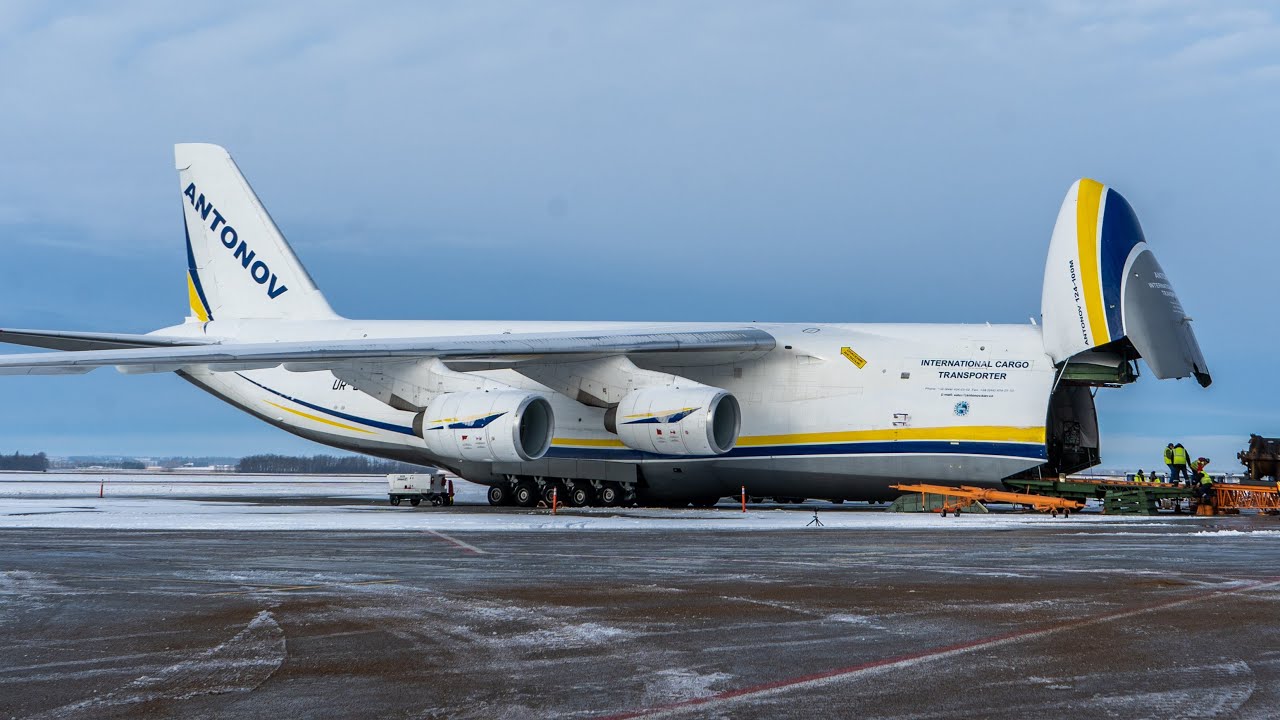
After a detailed technical assessment, the Antonov AN124 was selected as the only aircraft capable of transporting the turbine without extensive dismantling.
The AN124 is one of the largest cargo aircraft in the world, capable of carrying up to one hundred fifty tons. Its front loading ramp allows direct access to the cargo hold, while onboard cranes enable autonomous handling of extremely heavy equipment.
These capabilities make it particularly suitable for transporting turbines, generators and other oversized industrial machinery.
Logistics coordination from factory to destination
The operation required the coordination of several logistical stages across multiple countries. The turbine was first transported from the manufacturing facility to the departure airport using a special oversized road convoy.
At the airport, heavy lifting cranes were used to position the equipment inside the aircraft cargo hold. Avico teams coordinated closely with airport handling specialists to ensure that loading operations complied with safety regulations and aircraft weight distribution requirements.
At the same time, customs procedures were accelerated in order to avoid delays at departure and arrival.
Result: delivery within forty eight hours
The Antonov aircraft departed from France and landed in Dubai on a direct route. Upon arrival, the turbine was unloaded and immediately transported to the power generation facility.
Thanks to the rapid air transport solution, the installation was completed within the required timeframe and electricity production resumed shortly afterwards. The operation prevented significant financial losses and demonstrated the strategic value of air freight for heavy industrial equipment.
The AN124: a reference aircraft for heavy and oversize cargo
Technical capabilities
The Antonov AN124 remains one of the most capable heavy cargo aircraft currently in operation. Designed specifically for oversized logistics missions, it offers exceptional payload capacity and unique loading capabilities.
With a maximum payload of approximately one hundred fifty tons and a cargo hold exceeding thirty six meters in length, the aircraft can accommodate extremely large industrial components. The presence of an integrated loading ramp and onboard cranes further simplifies handling operations for complex cargo.
Comparison between major heavy cargo aircraft
| Aircraft | Maximum payload | Cargo holdlength | Special capabilities | Typical use |
| Antonov AN124 | 150 tons | 36 meters | Front loading ramp and onboard cranes | Oversize industrialequipment |
| Boeing 747 400F | 100 tons | 30 meters | Side cargo door | Large industrialcargo |
| IlyushinIL76 | 40 tons | 20 meters | High reliability and short runway capability | Remote industrialdestinations |
Each aircraft offers different advantages depending on the cargo characteristics, airport infrastructure and operational urgency.
Global availability through Avico’s network
Through its international network of cargo operators, Avico can mobilize heavy cargo aircraft across strategic logistics hubs worldwide. Locations such as Aberdeen support North Sea energy operations, while Dubai serves as a major gateway for Middle Eastern industrial projects.
Other hubs including Lagos facilitate logistics operations in West Africa, while remote Arctic or offshore sites require even more complex coordination.
This global coverage allows Avico to organize oversized cargo missions in more than one hundred fifty countries.
Oil and gas sector: equipment frequently transported by aircraft
Heavy air cargo plays a significant role in the oil and gas industry, where equipment failures or project delays can have major financial consequences.
Among the most frequently transported components are industrial turbines and electrical generators used in energy production facilities. Blowout preventers are another critical piece of equipment often transported by air due to their role in offshore drilling safety.
Large compressors, pumps and drilling equipment may also require rapid delivery to remote sites. In some cases, entire processing modules or prefabricated industrial structures are transported by aircraft when installation timelines are extremely tight.
Such operations highlight the growing importance of air freight in global energy infrastructure projects.
How Avico organizes heavy industrial cargo transport
Detailed operational analysis
Every heavy cargo mission begins with a detailed analysis of the technical and logistical constraints. Engineers evaluate the precise weight and dimensions of the equipment as well as the accessibility of both departure and destination sites.
Delivery timelines are also carefully reviewed in order to determine whether a charter aircraft is necessary or if a scheduled cargo route can be used.
Aircraft and handling strategy
Once the cargo characteristics are confirmed, specialists select the aircraft capable of accommodating the shipment safely. The choice depends not only on payload capacity but also on cargo hold dimensions, airport infrastructure and loading equipment availability.
Handling operations must also be planned carefully to ensure safe lifting and positioning of the equipment inside the aircraft.
Multi actor logistics coordination
Transporting industrial turbines requires coordination between multiple stakeholders including logistics engineers, airport ground handling teams, customs authorities and local installation crews.
Avico manages these interactions to ensure that every stage of the operation progresses smoothly, from factory pickup to final installation.
Real time operational monitoring
During the mission, clients receive continuous updates regarding cargo status and flight progress. This real time monitoring ensures full visibility and allows rapid intervention if any operational adjustments become necessary.
Budget and return on investment of turbine air transport
At first glance, transporting a heavy turbine by aircraft may appear costly. However, this cost must be compared with the financial consequences of prolonged industrial downtime.
A power generation facility losing production for several days may incur losses far exceeding the price of a cargo aircraft charter. By restoring operations quickly, air transport often delivers a strong return on investment.
For many industrial operators, the objective is not simply minimizing transport cost but protecting overall operational continuity.
Contact Avico for oversized industrial cargo transport
Transporting industrial turbines and heavy equipment requires specialized expertise, engineering coordination and access to large cargo aircraft.
Through its global aviation network and experience in complex logistics operations, Avico organizes heavy cargo air transport solutions for energy companies, industrial manufacturers and engineering contractors worldwide.
Companies facing urgent logistics challenges can explore solutions cargo Avico or contact Avico directly to demander un devis cargo hors gabarit for tailored aircraft charter solutions.
FAQ about industrial turbine air transport
Which aircraft can transport a thirty ton turbine
Aircraft such as the Antonov AN124, Boeing 747 400F or Ilyushin IL76 can transport turbines of this weight depending on the cargo dimensions.
Can a turbine be transported without dismantling it
Yes, provided that the dimensions fit within the aircraft cargo hold. In some cases partial disassembly may still be required to optimize loading.
Does Avico manage the full transport process
Yes. Avico provides door to door logistics coordination including road transport, aircraft charter, airport handling and delivery to the final industrial site.
How long does it take to organize such a transport operation
In emergency situations a cargo aircraft can sometimes be mobilized within twenty four hours. Standard operations generally require several days of preparation.
Which destinations can receive heavy cargo flights
Avico operates in more than one hundred fifty countries including remote industrial regions such as offshore installations, Arctic projects and desert energy facilities.
votre lecture
 AVICO News
In a world where supply chains are under constant pressure, execution speed has become a decisive competitive advantage. According to the latest ...
 AVICO News
Comme beaucoup de monde, on a démarré l’année 2021 avec une seule idée en tête : ON OUBLIE 2020 ! Même si ce début d’année ...
 AVICO News
🎞️ After a month without an episode, we are back with our mini-series, presenting today the Group Charter ✈️