


Medical evacuation by plane (MEDEVAC): how Avico organizes your repatriations

Over one million medical evacuations are carried out worldwide each year. The growth of international mobility, humanitarian missions, and professional expatriation has significantly increased the demand for urgent medical air transport. When an accident occurs thousands of kilometers from a properly equipped hospital, speed of response is crucial.
Medical evacuation by aircraft, commonly called MEDEVAC, is a strategic logistical and medical solution. It allows a patient to be transferred to a suitable facility while ensuring continuous medical monitoring throughout the flight.
Avico has been coordinating these operations for insurers, multinational companies, and tour operators facing medical emergencies abroad. From West Africa repatriations to medical flights during the COVID-19 pandemic, Avico has developed operational expertise in managing international medical emergencies.
What is medical evacuation by plane (MEDEVAC)?
A medical evacuation involves air transport of a patient in urgent or medically necessary situations, usually when local infrastructure cannot provide adequate care.
Definition: MEDEVAC, EVASAN, and medical repatriation
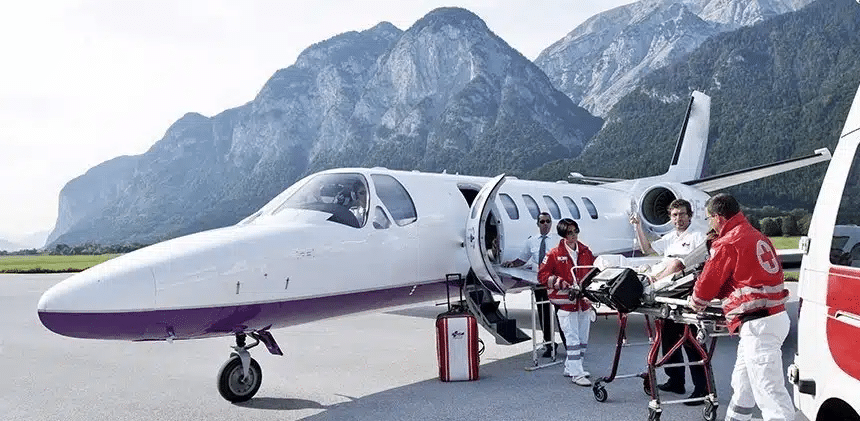
In international medical transport, several terms describe similar but distinct operations.
- MEDEVAC: urgent medical evacuation to a hospital equipped to treat the patient. The goal is to stabilize the patient quickly by transferring them to an appropriate medical facility.
- EVASAN (air evacuation): often used in military or humanitarian contexts; in civilian settings, it generally means a medical transfer to a regional hospital.
- Medical repatriation: occurs after patient stabilization, returning them to their home country for continued care in a familiar healthcare environment.
All cases involve transporting a patient aboard a medically equipped aircraft, with a specialized medical team and onboard monitoring systems.
Situations requiring urgent medical flights
MEDEVAC may be triggered in a variety of situations, including:
- Severe accidents in remote areas
- Acute illnesses requiring specialized medical equipment
- Medical complications during travel
- Limited infrastructure in the local healthcare system
- Natural disasters or health crises
Destinations with frequent operations for French expatriates include Morocco, Senegal, Madagascar, Vietnam, and the UAE. For companies or NGOs with staff abroad, having a provider capable of rapidly deploying a medical flight is a critical risk management tool.
Key actors in a MEDEVAC operation
International medical evacuations mobilize several specialized actors. At the core is the air charterer, responsible for organizing the aircraft, crew, and flight logistics. Avico operates 24/7 with certified medical and aviation partners.
A typical MEDEVAC team includes:
- Medical staff: physician and specialized nurse
- Aircraft equipped with stretcher and monitoring systems
- Coordination with departure and arrival hospitals
- Flight and health authorizations
MEDEVAC providers must comply with recognized international standards such as CAMTS and EURAMI, ensuring quality and safety.
Types of medical aircraft used by Avico
Different missions require different aircraft, depending on patient condition, distance, and airport access.
Medical helicopter (H145, EC135) — short distances, difficult access
Medical helicopters are often the first step in a MEDEVAC operation. They are ideal for retrieving patients from remote locations or transferring them to an airport capable of handling a medical plane. H145 and EC135 helicopters can carry a stretcher and full resuscitation equipment, typically covering a few hundred kilometers.
Helicopters land near hospitals, offshore platforms, or isolated sites, offering rapid intervention. For more details, see our guide on medical helicopters.
Medical turboprop (PC-12, King Air) — medium distances
Turboprop medical aircraft provide an efficient solution for intermediate distances. Models like the Pilatus PC-12 or King Air can operate from short runways while offering extended range and pressurized cabins. They are suitable for regional missions across Europe, Africa, or the Middle East, including transfers between African capitals before a long-haul flight to Europe.
Medical private jet (Citation, Learjet) — long distances
For long-haul international medical repatriations, medical private jets are the fastest option. Citation or Learjet aircraft are configured for stretcher transport with a complete medical team, ventilators, cardiac monitors, infusion pumps, and advanced monitoring systems. These jets can connect distant locations such as Lagos, Antananarivo, or Dubai to Paris in a few hours while maintaining continuous patient care.
Case study: repatriation from West Africa
Real-world operations illustrate the value of Avico’s MEDEVAC capabilities.
Scenario: expatriate accident, local hospital unequipped
A French engineer in Lagos suffers a road accident. The local hospital lacks the necessary equipment to manage complications. The insurer requests urgent medical evacuation to France.
Coordination in less than 6 hours
Upon request, Avico activates its operational network:
- Selects an available medical aircraft
- Deploys a flight physician and critical care nurse
- Prepares onboard medical equipment
- Secures flight and transit authorizations
Rapid coordination is often the most critical phase.
Flight: Lagos → Paris CDG, 6.5 hours with continuous care
The patient is transferred aboard a medical jet with full monitoring systems. Throughout the 6.5-hour flight, the medical team continuously monitors vital signs, coordinating with pilots and ground teams.
Arrival: direct admission to ICU
On arrival, an ambulance transfers the patient immediately to a Paris ICU, ensuring optimal post-flight care.
MEDEVAC and COVID-19: Avico experience
The COVID-19 pandemic significantly impacted specialized aviation operations.
297 repatriation flights (March–June 2020)
Avico coordinated 297 MEDEVAC and repatriation missions, covering stranded passengers and urgent medical transports.
Medical cargo flights
In parallel, Avico organized flights delivering essential medical equipment including masks, ventilators, and PPE to countries facing shortages.
Operational lessons for future crises
The experience reinforced logistics and medical protocols for emergency situations, highlighting the importance of rapid deployment capabilities for insurers and international companies.
How much does a medical evacuation cost?
Costs vary based on distance, aircraft type, medical equipment, and team composition.
| Distance | Aircraft type | Estimated price |
| Short European flight | Medicalturboprop | €15,000 – €25,000 |
| North Africa → Europe | Medical jet | €35,000 – €60,000 |
| Sub-Saharan Africa → Europe | Long-range jet | €80,000 – €140,000 |
| Asia → Europe | Long-range jet | €150,000 – €250,000 |
Prices typically include aircraft, crew, medical team, and equipment.
Role of insurance
Medical evacuation is usually covered by travel or expatriate insurance. Insurers often collaborate directly with air charterers to activate the operation once medically justified.
Who covers MEDEVAC costs?
- Individual travel insurance
- International health coverage for expatriates
- Employer of an overseas employee
- Humanitarian or government organizations
Rapid decision-making is crucial in all cases.
How to request a MEDEVAC with Avico: 5-step process
- Request medical evacuation
- Medical assessment with hospital partners
- Select aircraft and medical team
- Coordinate logistics and obtain flight authorizations
- Deploy the flight and transfer to destination hospital
Depending on patient location and crew availability, a medical aircraft can be mobilized within 2–6 hours. Avico coordinates insurers, local authorities, and hospitals to ensure seamless operations.
Organize an urgent MEDEVAC
Conclusion
As international mobility and professional assignments abroad grow, medical evacuation by aircraft has become an essential tool for managing health emergencies. Whether responding to accidents in remote areas, medical complications during travel, or global health crises, MEDEVAC operations enable rapid transfer to equipped hospitals with continuous care.
Leveraging its international network and experience—including during the COVID-19 crisis—Avico supports insurers, companies, and organizations in critical situations, providing secure and rapid medical air transport.
FAQ – Medical evacuation by plane
What is the difference between MEDEVAC and medical repatriation?
MEDEVAC is urgent medical evacuation to a hospital with adequate facilities. Medical repatriation occurs after stabilization, returning the patient to their home country for ongoing care.
Can patients on assisted ventilation be transported?
Yes. Some aircraft are equipped with stretchers, ventilators, cardiac monitors, and full resuscitation equipment. Patients are accompanied by a physician and nurse.
Does travel insurance cover MEDEVAC?
Most travel or expatriate insurance policies cover MEDEVAC costs if the transfer is medically justified. Avico can coordinate directly with insurers.
How quickly can a MEDEVAC be deployed?
Aircraft can be mobilized within 2–6 hours depending on patient location and crew availability.
Can Avico organize MEDEVAC from Africa?
Yes. Avico operates regularly from countries such as Senegal, Morocco, and Madagascar through its African partner network.
votre lecture
 Blog
Blog
The global helicopter market is highly dynamic, with nearly 1,000 aircraft changing ownership annually. These transactions span ...
 Blog
Blog
Industrial globalization increasingly depends on logistics networks capable of moving high value and highly technical products quickly ...
 Blog
Blog
In a tourism market marked by strong seasonality and constant margin pressure, controlling air transport represents a strategic lever for ...