


Private Air Ambulance: How Does Aeromedical Evacuation Work?

When a patient is hundreds or thousands of kilometres from a facility capable of providing the care they need, air transport can become an essential link in that care. A private air ambulance makes it possible to organise a medically supervised transfer within a timeframe suited to the clinical situation, with an aircraft configured and a medical team assembled to match the patient’s needs.
Unlike a standard commercial flight, aeromedical evacuation is designed around the health condition of the person being transported. A stretcher, oxygen, monitoring equipment, ventilation or other devices may be required depending on the situation. IATA notes that transporting patients who need assistance or specific medical equipment may require a prior medical assessment and suitable arrangements.
Selecting an aircraft, mobilising a medical team and coordinating with healthcare facilities are therefore all part of the same operation. In an urgent flight, aeronautical and administrative requirements have to be handled in parallel with the medical planning.
When a Private Air Ambulance Becomes Necessary
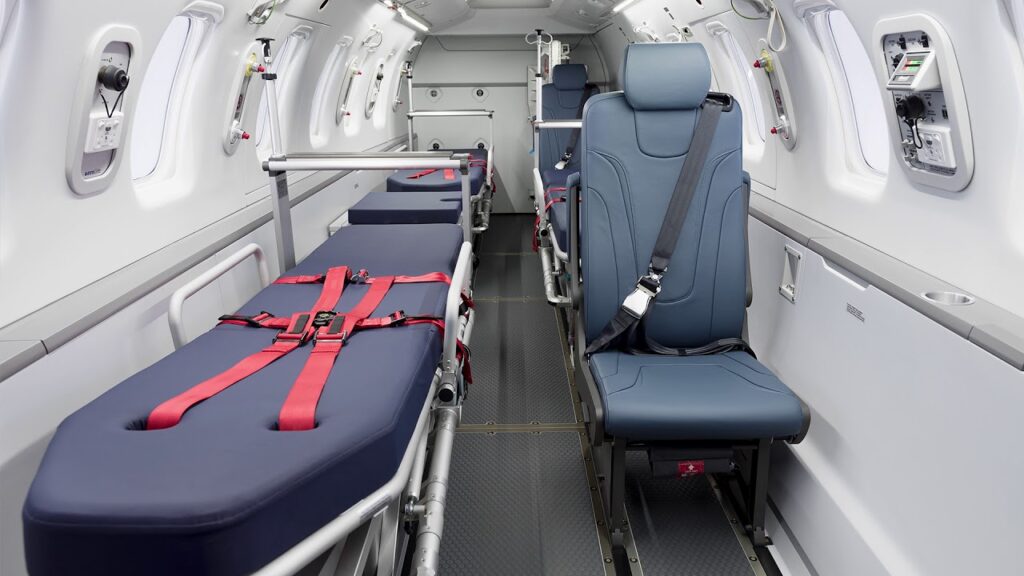
Turning to a private medical aircraft responds to a range of situations. It may involve an accident abroad, a condition requiring technical facilities unavailable locally, or the transfer of a stabilised patient to a facility in their home country.
The difference from ordinary medical transport lies mainly in the level of assistance required and the distance to be covered. Depending on the situation, a commercial flight with assistance may sometimes be enough. In other cases — particularly when the patient must remain lying down or needs continuous care — a specially configured aircraft becomes more appropriate.
EASA distinguishes air ambulance operations from emergency HEMS operations: an air ambulance mission is a medical transport operation that remains subject to normal air transport rules, while HEMS operations follow a specific framework when immediate intervention is required.
International Medical Repatriation
Medical repatriation flight applies when a patient needs to be transferred from a foreign country to a better-suited care facility, often in their country of residence or origin.
This can arise after an accident, an acute illness or a medical complication occurring during a trip. Repatriation is not, however, automatically synonymous with an absolute emergency: the decision depends on the patient’s condition and the assessment of healthcare professionals, who evaluate whether transport is possible and under what conditions.
Avico distinguishes between medical repatriation, which generally concerns a patient whose condition is sufficiently stabilised, and urgent medical evacuation, intended to transfer someone quickly to a facility able to respond to a critical situation.
In both cases, the organisation has to take several factors into account:
- the patient’s clinical condition and their ability to tolerate the flight;
- the distance and duration of the journey;
- the type of aircraft required;
- the medical equipment to be carried;
- the composition of the medical team;
- the necessary authorisations and formalities;
- ground handling before and after the flight.
The goal is to ensure continuity of care between the departure and arrival facilities — not simply to move the patient from one country to another.
Inter-Hospital Transfer for a Patient Requiring Specific Care
A private air ambulance can also be used for an inter-hospital transfer. This applies in particular to patients who need to reach a specialist department or a facility with specific technical resources.
Air transfer can become relevant when the distance by road is too great, or when the time required by road is incompatible with the medical situation.
The type of aircraft is then determined by the mission. According to Avico, solutions can include medical aircraft suited to transporting a patient on a stretcher, including when they are ventilated or intubated.
The decision to transport a patient by air, however, is a medical judgment. Fitness to fly, the care required during the journey and any contraindications must be assessed by qualified professionals.
The Technical Configuration of a Medically Equipped Flight
A private medical jet is not simply an aircraft fitted with a stretcher. Its configuration has to be adapted to the patient’s condition and the nature of the transfer.
The aircraft can be arranged to accommodate a patient lying down and to allow the use of medical devices during the flight. The choice of aircraft depends in particular on the distance, the clinical condition, the number of accompanying persons and airport constraints.
IATA publishes a regularly updated Medical Manual covering health issues related to flight operations, ill passengers and the management of medical situations on board.
Onboard Medical Equipment and Medical Staff
The level of equipment varies according to the mission. A patient who simply needs medical monitoring will not require the same resources as someone who needs intensive care for the entire journey.
According to Avico, some missions can be carried out with a medical stretcher, monitoring devices and assistance suited to ventilated or intubated patients. The charter operator also states that it can mobilise a medical team on board according to the needs of the mission.
In some configurations, the aircraft effectively becomes a mobile care unit. The choice of equipment cannot, however, be standardised: it depends on the medical assessment carried out beforehand.
Transporting medical equipment also requires taking applicable aeronautical and regulatory constraints into account. Equipment, oxygen cylinders and other devices carried on board must be compatible with flight conditions and the operator’s procedures.
Coordination with Departure and Arrival Hospitals
The success of an aeromedical evacuation relies as much on coordination as on the aircraft itself.
Before departure, the necessary medical information must make it possible to determine the appropriate type of transport. The departure facility then prepares the patient for transfer, while the flight team organises care on board.
On arrival, the ground ambulance and the receiving facility must be ready to continue care without unnecessary interruption.
This chain can be particularly complex for an international repatriation. It then involves medical teams, the air operator, airports, the relevant authorities, insurers and sometimes several ground transport providers.
Avico states that it manages this coordination between medical teams, air operators, administrative authorities and assistance services.
Preparation also has to account for airport-specific constraints. The chosen aircraft must be able to operate at the selected airport, and schedules must be compatible with flight authorisations and ground handling arrangements.
How Avico Organises This Type of Charter
For a medical mission, chartering is therefore a multi-layered operation. The right aircraft has to be identified, its availability confirmed, the medical team assembled, authorisations organised, and logistical continuity ensured through to the destination hospital.
Avico states that it has an international network of certified operators and a specialised team able to handle urgent medical requests.
24/7 Availability of the Operations Desk
A medical emergency doesn’t keep office hours. This is why Avico states that it operates a 24/7 operations desk, available around the clock for urgent medical charters, including repatriations and medical evacuations.
When a request comes in, the first information sought typically concerns the patient’s condition, their location, the departure facility, the destination hospital and any specific medical constraints. This information then guides the search toward the most suitable aircraft and resources.
Availability does not, however, mean that every aircraft can take off immediately. Authorisations, traffic rights, airport availability and operational constraints can all affect the actual timeframe.
For the most urgent requests, Avico states that it is able to present an initial solution quickly, and notes that some missions can be launched at very short notice, subject to administrative and operational constraints.
Administrative Coordination and Insurance
An international aeromedical evacuation often requires managing several administrative aspects alongside medical preparation.
Depending on the destination, traffic or overflight authorisations may be required. The operator must also verify the operating conditions of the departure and destination airports.
Insurance is another essential link. In many situations, medical repatriation is organised as part of international assistance or insurance cover. The insurer can then instruct a provider to coordinate the transport.
Avico states that, as part of its urgent charters, it manages contracts, traffic rights, insurance, ground operations and the associated logistics.
This centralisation limits the number of points of contact for the client or the insurer. It does not, of course, replace the medical decision: the choice to transport a patient and the conditions of their care remain determined by healthcare professionals.
To learn more, read our dedicated article on aeromedical evacuation.
Conclusion
A private air ambulance is a specialised solution for transporting a patient when medical conditions, distance or access to a care facility make dedicated air transport necessary.
Whether an international repatriation or an inter-hospital transfer, every mission has to be built around the patient’s condition. The choice of aircraft, the equipment on board, the medical staff and ground transfers all have to be coordinated to ensure continuity of care.
The success of such a transport therefore relies on a combination of medical, aeronautical and logistical expertise. In an urgent situation, the ability to mobilise the various parties quickly becomes a decisive factor.
For an urgent request, contacting us urgently makes it possible to share the initial information needed to assess and organise an air medical transport.
votre lecture
 Blog
Blog
A professional football season isn’t decided on the pitch alone. Between league fixtures, domestic cups and European competitions, clubs ...
 Blog
Blog
Long reserved for the most frequent business aviation travelers, the private jet membership card has gradually established itself as an ...
 Blog
Blog
In international transport, every hour can count. An industrial part halting a production line, medical equipment needed urgently, or goods that ...