


Optimising VIP Passenger Logistics at Le Bourget Business Aviation Terminal

With dedicated business aviation facilities and an immediate proximity to Paris, Paris-Le Bourget Airport has established itself as a key hub for private jet travel. Groupe ADP describes it as Europe’s leading business aviation airport, while its location just a few kilometres north of the French capital makes it a particularly convenient gateway for business travellers.
For a company, however, this proximity alone does not guarantee a completely seamless journey. When an executive, delegation or key client travels by private jet, the quality of the experience also depends on the entire chain organised around the flight: schedules, documentation, reception, ground transfers, baggage, last-minute requirements and coordination with the crew or operator.
The Le Bourget business aviation terminal is specifically designed to meet these expectations, providing an environment aimed at reducing processing times while preserving passenger privacy. Behind this apparent simplicity, however, lies a logistics operation that needs to be carefully anticipated — this is where the role of a travel manager or specialist aviation partner becomes particularly important.
Why Le Bourget Is a Key Logistics Hub for Business Aviation
Le Bourget occupies a unique position in the Paris aviation landscape. Unlike major commercial airports, the airport is structured around business aviation and hosts significant maintenance, handling and support activities for operators.
Its location is also an operational advantage for passengers travelling from Paris. The airport’s proximity to the capital reduces ground transfer times, while its dedicated facilities separate the business aviation experience from that of a conventional commercial airport.
Groupe ADP notably highlights the comprehensive business aviation ecosystem surrounding Paris-Le Bourget, home to a range of maintenance, handling and aviation service providers.
For companies, this concentration of expertise makes it easier to organise tailored journeys. It also requires precise coordination between the various stakeholders involved.
A Fully Dedicated Terminal, Without the Constraints of Commercial Airports
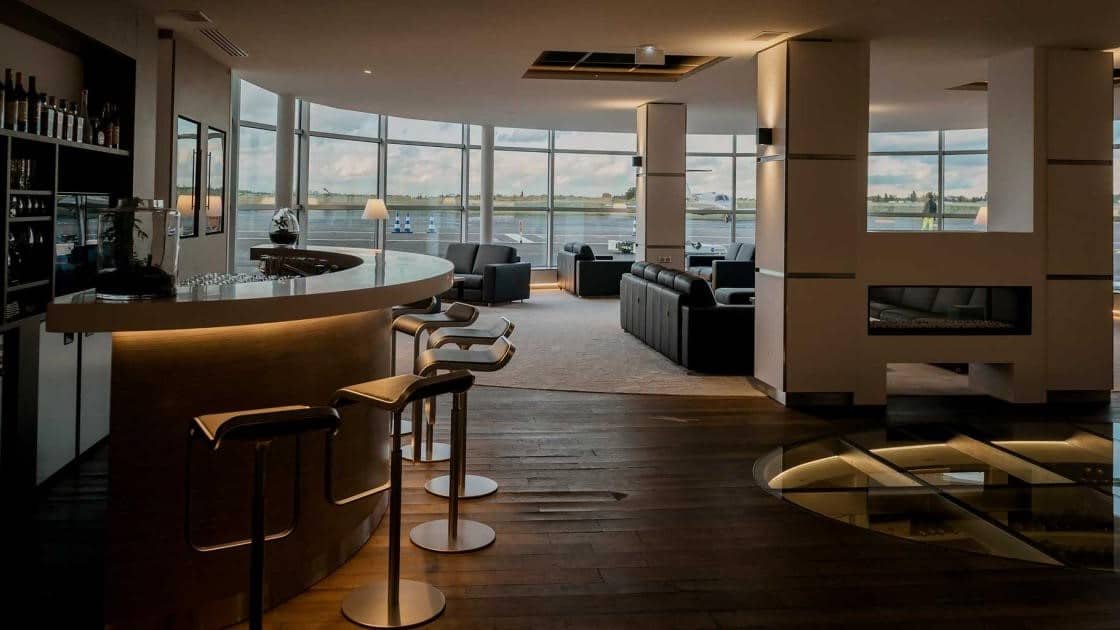
One of Le Bourget’s main advantages lies in its business aviation-focused operation. Passengers do not follow the traditional journey found at a major commercial airport, with long queues and vast departure or connecting halls.
The terminals and FBOs operating at the airport are designed to accommodate private aviation passengers in a more discreet environment. Paris Aéroport’s official documentation lists several terminal and FBO operators at Le Bourget, including Signature, Dassault Falcon Services, Sky Valet, Universal Aviation France and Jetex.
The passenger journey can therefore be considerably shorter. On a private flight, passengers arrive at the business aviation terminal, complete the necessary checks and formalities, and then proceed to their aircraft without navigating the complex infrastructure of a commercial hub.
This level of efficiency is an obvious advantage for executive travellers. It does not, however, mean that every formality disappears: requirements depend in particular on the destination, passengers’ nationality and the type of flight. Certain documents must be prepared in advance to prevent an administrative issue from disrupting departure.
The Le Bourget VIP terminal should therefore be viewed as a streamlined environment, rather than a facility without formalities.
The Specific Expectations of Executive Travellers
Business travel follows a different logic from leisure travel. For an executive, time spent travelling is directly connected to the professional schedule. A delayed car, a change in departure time or a documentation issue can have consequences for a meeting, negotiation or business event.
Privacy is also an important consideration. The way business aviation terminals operate helps limit passenger exposure and provides greater discretion around business travel.
There are also expectations regarding comfort and personalisation: individual reception, chauffeur-driven transfers, baggage assistance and flexible scheduling. For its private jet solutions, Avico notably highlights access to private terminals, ground transfers and 24/7 assistance.
The quality of a VIP journey therefore depends on much more than the aircraft itself. It relies on the ability to coordinate the entire passenger journey.
The Role of the Travel Manager in Flight Coordination
The business aviation travel manager is at the centre of this organisation when a company manages executive or employee travel internally.
Their role is not simply to book a flight. They must ensure that all elements of the journey are consistent: schedules, passengers, transfers, documentation and any specific requirements. This responsibility becomes even more important when several travellers are involved or when the programme changes rapidly.
Preparing Passenger Documents and Formalities
A private jet journey also requires thorough documentation. Passports, visas where required, passenger information and destination-specific requirements must be checked sufficiently in advance.
The speed of processing at the terminal does not remove the need for this preparation. On the contrary, the streamlined nature of the terminal relies on effective planning beforehand. For a travel manager, the objective is to prevent a minor administrative detail from blocking or delaying a journey that has often been scheduled around very precise timings.
Passenger information must also be provided within the required timeframes to the relevant stakeholders. Depending on the destination, authorities may impose specific requirements. The challenge is therefore to centralise information and verify every stage before the day of departure.
This preparation also makes it possible to anticipate specific requirements, such as oversized baggage, pets, specialist equipment or particular onboard service requests. Avico, for example, indicates that special requirements can be taken into account when requesting a charter, allowing the necessary authorisations and arrangements to be anticipated.
Coordinating Chauffeurs and the Welcome Protocol
The journey between the company’s headquarters and the airport is an integral part of the passenger experience. A chauffeur service that is poorly synchronised with the departure time can eliminate part of the time-saving advantage offered by a private jet.
The travel manager must therefore consider the journey as a complete chain: pick-up time, estimated driving time, safety margin, arrival at the terminal, formalities, boarding and departure. The same principle applies on arrival: when an executive needs to go directly to a meeting or another location, the chauffeur must be in position at the right time.
This coordination may also include specific protocol requirements. Welcoming a key client, accompanying an international delegation or handling a confidential trip may each require a different level of service.
The principle behind private jet passenger logistics at Le Bourget is precisely to avoid treating the flight as an isolated sequence and instead view it as one stage of a broader business journey.
How Avico Supports Companies at This Terminal
For a company that regularly organises business aviation travel, having a single point of contact capable of coordinating operations can significantly simplify the process.
Avico has operated as an air charter broker since 1996 and states that it works with a network of more than 200 airlines meeting its safety and quality standards. Its activities include private jet hire and chartering different types of aircraft. The objective is to allow the client to delegate part of the operational complexity while retaining control over its own requirements.
To explore the characteristics of the main airports used by business aviation in greater detail, you can also discover Europe’s leading business aviation airports.
A Single Point of Contact from Departure to Arrival
The value of a single point of contact becomes particularly clear when a journey involves multiple requirements.
A company can provide a set of specifications covering the destination, number of passengers, preferred schedule, comfort requirements and ground transport constraints. The broker can then source the appropriate aircraft and coordinate the different elements of the operation. This approach prevents the travel manager from having to manage multiple exchanges with the airline, terminal, chauffeurs and other service providers.
The model is particularly relevant for companies organising occasional trips or those for which private aviation does not represent enough volume to justify a dedicated internal team.
Private jet hire can also be adapted to different group profiles. Avico states that it can provide business aircraft for small groups and also arrange larger charters depending on requirements.
For companies wishing to delegate this organisation, our private jet hire service provides personalised support, including aircraft selection and coordination of the journey.
Managing Disruptions and Last-Minute Changes
It is often when a programme changes that the value of a specialist point of contact becomes most apparent.
An extended meeting, a change in passenger numbers, a modified destination or a ground delay can affect the entire logistics chain. In business aviation, schedule flexibility is one of the model’s main advantages, but it requires an organisation capable of responding quickly.
Avico states that it provides personalised 24/7 assistance for its private jet solutions. For a travel manager, this availability provides an operational point of contact when a journey does not unfold exactly as planned.
Disruption management can also involve ground transportation. If the departure time changes, the chauffeur needs to be informed. the aircraft changes, the meeting point may need to be adjusted. And if an additional passenger joins the journey, the relevant information must be updated.
The performance of the system therefore depends less on eliminating every potential disruption than on the ability to absorb and resolve them quickly.
VIP Logistics Starts Before Passengers Even Reach Le Bourget
The main takeaway is ultimately straightforward: the experience provided by a business aviation terminal begins well before passengers enter the building.
Le Bourget helps reduce journey times and provides an environment specifically designed for business aviation. But this efficiency depends on rigorous preparation of passengers, documentation and transfers.
For a company, a travel manager can rely on a specialist broker to centralise the preparation and monitoring of the journey. This approach becomes particularly valuable when travellers have demanding schedules, when several stakeholders need to be coordinated or when the flight may change at the last minute.
The Le Bourget business aviation terminal is therefore more than simply a departure point. It is the centre of a VIP logistics chain in which every minute and every detail can matter.
FAQ: VIP Passenger Logistics at Le Bourget
Can a travel manager coordinate directly with Avico?
Yes. Avico can work directly with a company’s travel manager as a single point of contact for its flights. Its teams can support journey planning, aircraft selection and coordination of the various elements required for the operation.
Does Le Bourget Airport require specific passenger formalities?
Formalities are generally faster and simpler than at major commercial airports, but they do not disappear. Certain documents must be prepared in advance depending on the destination, passengers’ nationality and the regulatory requirements applicable to the flight.
Why choose Le Bourget for business travel?
Its focus on business aviation, proximity to Paris and dedicated infrastructure help reduce processing times while providing a more private environment than a conventional commercial airport. Groupe ADP describes Paris-Le Bourget as Europe’s leading business aviation airport.
Can a chauffeur transfer be arranged from the terminal?
Yes. Ground transfers can be incorporated into the overall organisation of the journey. Avico specifically mentions chauffeur-driven transfers among the services that can accompany a private jet hire.
Conclusion
For companies, optimising VIP passenger logistics at the Le Bourget business aviation terminal is about much more than booking a private jet. It means synchronising the entire journey: documentation, schedules, reception, terminal, aircraft and ground transfers.
Le Bourget provides a particularly suitable environment for this approach, thanks to its dedicated business aviation infrastructure and proximity to Paris. To take full advantage of these benefits, however, careful planning remains essential.
A travel manager can rely on a specialist partner to simplify communication and provide end-to-end monitoring, including when the programme changes at the last minute.
Organise your VIP passenger logistics → contact Avico to speak with a team specialising in business aviation travel arrangements.
votre lecture
 Uncategorized
Traveling with your dog or cat is far from a minor formality. On commercial flights, pet transportation conditions vary depending on the airline, ...
 Uncategorized
With its volcanic cliffs, white villages perched above the caldera, and world-famous sunsets, Santorini has established itself as one of ...
 Uncategorized
The United Arab Emirates now hold a strategic position in economic exchanges between Europe, Asia, and the Middle East. With Dubai as a ...