


Helicopter air transport by cargo aircraft: how to ship rotors worldwide

The global helicopter market is highly dynamic, with nearly 1,000 aircraft changing ownership annually. These transactions span international sales, redeployments to offshore operations, humanitarian missions, mining projects, and aerial surveillance. In this context, transporting a helicopter by cargo aircraft has become a key logistical solution for moving these machines quickly and safely across long distances.
Unlike fixed-wing aircraft, helicopters are often operated in remote or challenging locations such as offshore platforms, mountainous terrain, or isolated mining sites. When an aircraft needs to be transferred between continents, sent for maintenance, or delivered to a new operator, specialized air freight becomes the fastest and most reliable method.
But how exactly do you ship a helicopter via cargo aircraft? Should the rotor be disassembled? Which aircraft can accommodate such a load? What regulatory and logistical constraints apply? This guide explores the essential steps of helicopter air transport, the aircraft used, and best practices, while highlighting Avico’s international operations, particularly in Africa through its stake in Westair Helicopters.
Why transport a helicopter by air
Transporting a helicopter by cargo aircraft addresses several strategic needs for operators and manufacturers. In a sector where availability is critical, rapid deployment provides a clear operational advantage.
International sales or acquisition
The second-hand helicopter market is highly globalized. An aircraft operating in Europe can be sold to an African, Asian, or South American operator in just a few weeks. Popular models frequentlyshipped include the Airbus H125, H145, Bell 412, and Sikorsky S-76.
When the distance exceeds practical ferrying capabilities—such as from Europe to Southern Africa—air freight drastically reduces transit times. A cargo flight can deliver a helicopter in less than 48 hours, compared to several days or weeks for ferrying with intermediate stops.
Deployment to isolated regions
Helicopters are widely used in areas with limited accessibility, including offshore platforms, remote mining sites, humanitarian missions, and border surveillance. Shipping helicopters by cargo aircraftallows rapid positioning on the operational theater, minimizing downtime.
Strategic offshore hubs include Aberdeen for the North Sea, Houston for the Gulf of Mexico, and Port Harcourt for Nigeria’s Niger Delta. Operators often need a replacement aircraft within days to maintain contractual commitments.
Maintenance and overhaul abroad
Some maintenance operations require sending the helicopter to specialized centers or the manufacturer’s facilities for major inspections, avionics upgrades, or structural component replacements. A cargo aircraft charter becomes the fastest solution for transporting the aircraft safely and efficiently.
Operational urgency
In offshore, humanitarian, or mining operations, an aircraft out of service can significantly impact operations. Severe malfunctions may halt offshore transport missions, disrupt mining logistics, or delay emergency response efforts. In such cases, rotor air transport allows rapid delivery of a replacement helicopter, sometimes within 24 hours in emergency scenarios.
Disassembly: key steps before transport
Most helicopters cannot be loaded into a cargo aircraft intact. To optimize volume and ensure safety, partial disassembly is usually necessary.
Rotor and tail: when to remove
The main rotor, blades, and occasionally the tail boom are removed to reduce the aircraft’s height and width for safe loading. These elements are then packed in specialized crates designed for air transport.
| Component | Reason for removal |
| Main rotor | Reduces height and width for cargo hold |
| Blades | Protects against damage during handling |
| Tail rotor/boom | Facilitates loading in restricted spaces |
| Landing gear (sometimes) | Optimizes volume and weight distribution |
Regulatory constraints
Disassembly and reassembly must be performed by certified personnel in accordance with manufacturer maintenance manuals, international airworthiness standards, and Part-145 certification procedures. After reassembly, a full airworthiness inspection is required before the helicopter can return to service.
Required technical documentation
International helicopter transport requires complete documentation, including maintenance logs, airworthiness certificates, disassembly and packing records, and transport documentation. These files ensure safety, simplify customs formalities, and guarantee traceability.
Which aircraft can carry a helicopter?
The choice of cargo aircraft depends on the helicopter’s weight, dimensions, and degree of disassembly.
AN-124: the choice for heavy helicopters
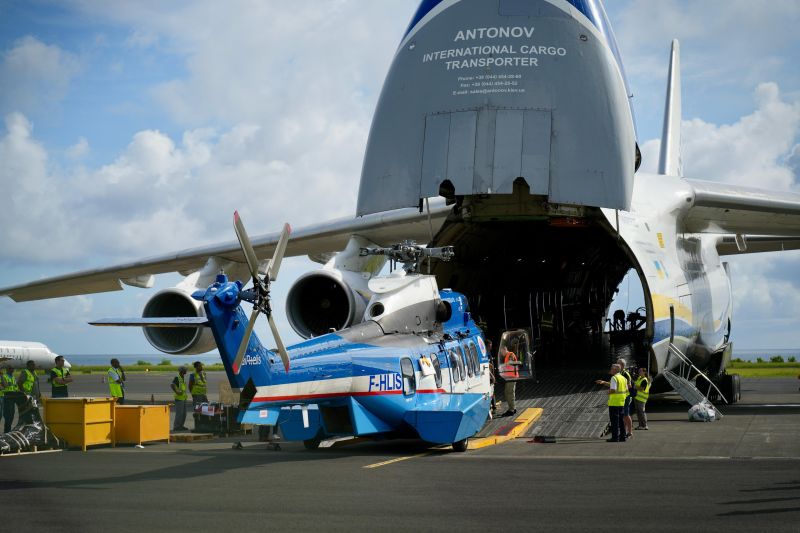
The Antonov AN-124 is one of the world’s most powerful cargo planes, capable of carrying military and offshore transport helicopters as well as oversized industrial equipment. Its massive cargo hold accommodates models such as the Airbus Super Puma, CH-47 Chinook, and Sikorsky S-92, with front loading ramps and onboard cranes facilitating rapid and secure loading.
Boeing 747-400F and IL-76: versatile intermediates
The Boeing 747-400F and Ilyushin IL-76 are ideal for medium-weight helicopters and other large aerospace components. Their large cargo doors allow for loading disassembled rotorcraft safely.
C-130 / ATR 72F for light helicopters
Light helicopters like the Airbus H125, Robinson R44, or other utility models can be transported using compact cargo aircraft such as the C-130 or ATR 72F after partial disassembly.
Recommended helicopter-aircraft pairings
| Helicopter type | Average weight | Recommended cargo aircraft |
| Robinson R44 | 1 t | ATR 72F / C-130 |
| Airbus H125 | 2.3 t | C-130 / IL-76 |
| Airbus H145 | 3.7 t | IL-76 / B747-400F |
| Bell 412 | 5.4 t | B747-400F / AN-124 |
| Sikorsky S-92 | 12 t | AN-124 |
Choice also depends on airport infrastructure, loading equipment, and access at both departure and arrival points.
Westair Helicopters case: Avico operations in Africa
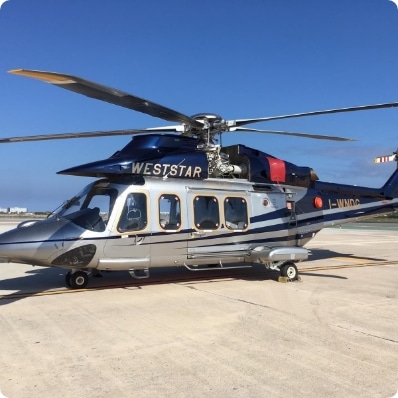
Africa represents one of the fastest-growing markets for utility helicopters, especially in mining and energy sectors.
Avico majority shareholder of Westair
Avico’s stake in Westair Helicopters strengthens its presence in Southern Africa, with operations in Zambia, Zimbabwe, and Botswana. The fleet of roughly 15 helicopters supports personnel transport, mining logistics, aerial surveillance, and operational missions.
Deployment to isolated mining zones
Mining projects are often located in extremely remote regions. Helicopters provide rapid access for teams, inspections, and daily logistical operations. Cargo air transport is essential to deploy aircraftfrom Europe or the Middle East to these sites efficiently.
Coordination between air transport and local operations
Avico’s model integrates international cargo transport with local operational support. The process covers freight organization, air transport to Africa, local reassembly, and operational deployment. This approach ensures minimal downtime and aligns with oil and gas industry requirements, where aircraft availability is crucial.
International regulations for helicopter transport
Transporting a complete rotorcraft requires adherence to strict international regulations covering safety, customs, and insurance.
IATA and aerospace transport standards
IATA defines standards to secure loads, prevent structural damage, and ensure compliance. Logistics teams must verify weight distribution, anchoring points in the cargo hold, and proper handling procedures.
Customs: ATA Carnet and temporary import
International transport may require temporary importation procedures such as ATA Carnet or admission for maintenance. In case of sale, permanent import rules may apply. Proper documentation ensures smooth customs clearance.
Insurance and liability
Helicopters are high-value assets, typically ranging from €1 million to €20 million. Specialized insurance covers handling, loading, and in-flight risks during transport.
How Avico organizes helicopter air transport
From technical analysis to delivery
Each project begins with a detailed technical assessment, including dimensions, weight, dismantling options, and airport capabilities. Avico selects the most suitable cargo aircraft and plans handlingoperations. The transport sequence typically includes partial disassembly, packaging, loading, air transport, and reassembly at the destination.
Specialized handling partners
Helicopter transport requires certified maintenance teams, cargo handlers, and customs brokers. Avico leverages a global network of partners to ensure safety and efficiency, offering a comprehensive specialized air freight solution.
Transporting a helicopter by cargo aircraft is a highly specialized operation essential for operators, manufacturers, and industries such as offshore, mining, and humanitarian missions. Whether forinternational sales, deployment to isolated regions, maintenance, or urgent replacement, air freight ensures rapid and secure movement across long distances.
Through its expertise in helicopter charters and international presence—including Westair Helicopters in Africa—Avico supports operators in managing every aspect of these missions.
Need to ship a helicopter? Experts can assess your project and organize a customized transport solution. Request a quote: /devis-charter-cargo/
FAQ – Helicopter air transport
Do helicopters need to be disassembled for cargo transport?
Yes. The main rotor and blades are generally removed to reduce size and allow safe loading in the aircraft hold.
What is the cost of helicopter air transport?
Costs typically range from €30,000 to over €150,000 depending on helicopter size, distance, and urgency. Quotes are available on request.
Is the helicopter airworthy after transport?
Yes, after reassembly by certified personnel (Part-145) and a full airworthiness inspection before return to service.
Can Avico ship a helicopter to Africa?
Yes. Through its partnership with Westair Helicopters, Avico regularly transports helicopters to Southern and Central Africa.
How long does it take to organize transport?
Generally between 5 and 15 days depending on destination, aircraft availability, and customs procedures.
votre lecture
With its European institutions, international organisations and strong economic ecosystem, Brussels holds a unique position in business travel ...
 Blog
Blog
When a patient is hundreds or thousands of kilometres from a facility capable of providing the care they need, air transport can become an ...
 Blog
Blog
A professional football season isn’t decided on the pitch alone. Between league fixtures, domestic cups and European competitions, clubs ...